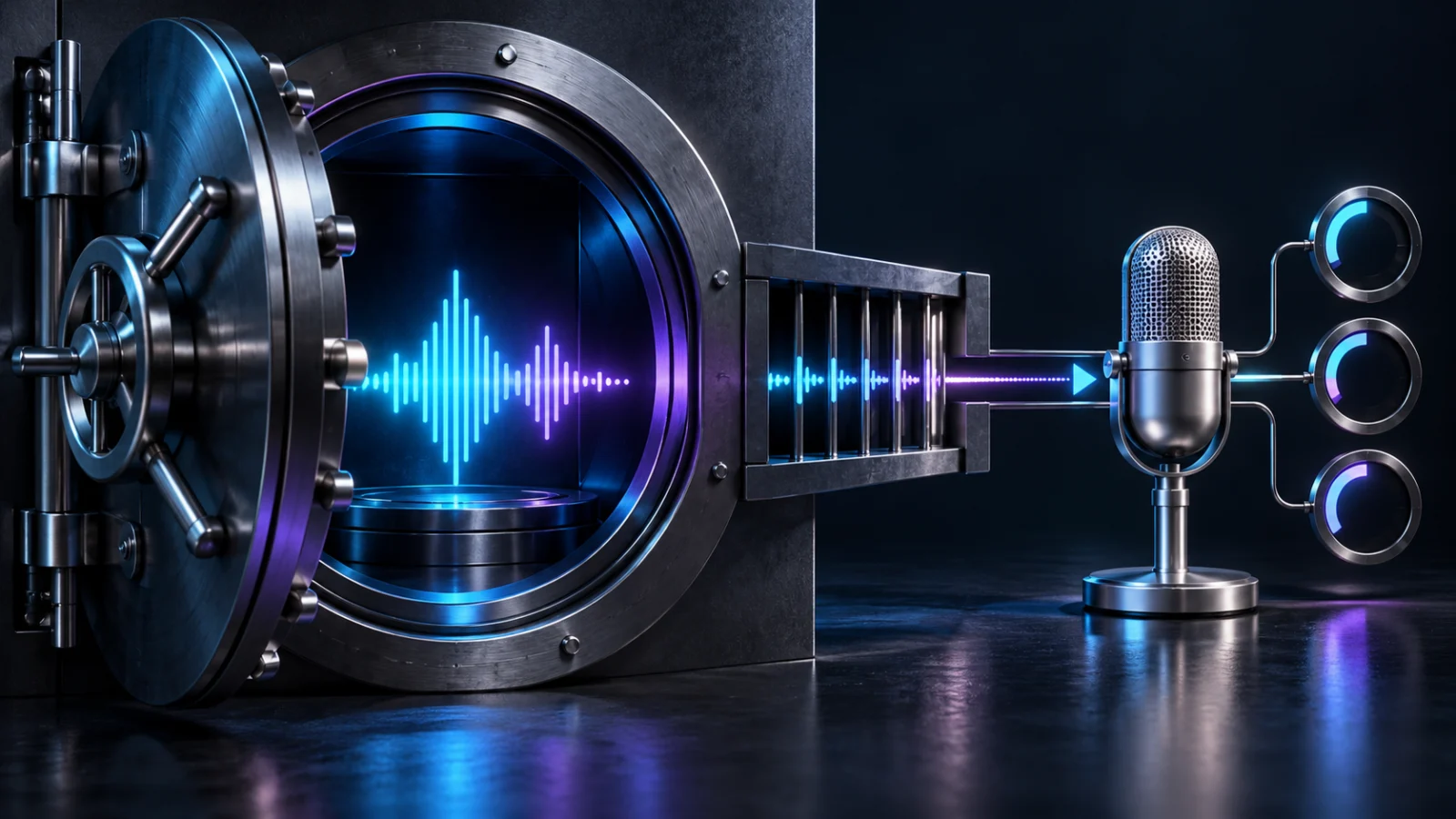
A public voice-generation application can consume processing time, storage and provider usage whenever someone submits a request. That makes resource controls part of the feature, not an optional improvement after launch. A secure design protects credentials, validates requests and stays honest about whether a functioning speech backend is connected.
Keep authority on the server
Provider credentials should remain in an appropriately protected server-side configuration. Do not place them in browser JavaScript, page source, public logs or downloadable examples. A client should request an allowed operation, not choose an arbitrary destination URL or supply a secret on behalf of the application.
Use a verified licensed voice catalog and validate the submitted voice identifier against it. Do not accept arbitrary model names, upload-based cloning instructions or unsupported provider options merely because a form can send them. The available controls should reflect actual approved capabilities.
Bound the request and the cost
Limit script length, supported settings, request frequency, execution time and output size according to tested capacity. OWASP identifies unrestricted resource consumption as an API security concern. Authentication alone does not make an expensive operation safe to call without limits.
Set appropriate usage and cost controls before connecting a paid provider. A free trial or account key is not authorization to incur charges indefinitely. If no approved backend is available, keep generation inactive and explain the dependency rather than simulating a successful result.
Protect output handling
Validate returned data before treating it as an audio file. Keep temporary output outside unrestricted public storage where the design requires access control. Use limited, expiring delivery permissions where appropriate and avoid accepting user-controlled filesystem paths.
Consider what scripts, identifiers, logs and output files are retained. Minimize unnecessary personal information and document actual retention rather than inventing a standard duration. Do not log credentials or full private request contents simply because debugging is easier that way.
Test failure paths deliberately
Check invalid inputs, unavailable service, unsupported voice, rate limits, expired downloads and unauthorized requests. A mock response can test application behavior, but it is not evidence that real speech generation works. Verify an actual authorized request produces playable audio before describing the service as functioning.
Key takeaway: a dependable generator combines a usable interface with controlled authority and bounded resource use. The button is only the visible part of a system that must protect both the operator and the people whose material it handles.
Sources & further reading
Source review: October 29, 2026. This is a researched educational feature, not an interview or a claim of firsthand testing. Legal, health and business decisions require context-appropriate professional guidance.